
Target binder, E3 binder, or both: built from structure, matched for productive ternary-complex geometry, and validated in cells.
Addressing the structural and functional bottlenecks holding back targeted protein degradation pipelines.
The problem: CRBN and VHL dominate the field's E3 ligase-related module choices, driving acquired resistance and limited tissue specificity.
What you get instead:Expanding past CRBN and VHL usually means panning a physical library against a new ligase from the ground up. You get a target-binding module built directly from your target's structure instead — compatible with MDM2, IAP, or your proprietary E3 system — with binding activity already confirmed in cells before it reaches your bench.
The problem: Small-molecule ligand discovery for novel E3 ligases runs into family-wide promiscuity — candidate ligands often bind several ligases within the same family, and where they do land on the right one, binding competition inside a conserved pocket keeps affinity low.
What you get instead:A protein binder built directly against your chosen E3 ligase's structure — engineered for the selectivity and affinity a small-molecule screen can't reliably deliver against a new ligase family member.
The problem: A degrader still needs a target-binding module. Flat surfaces, disordered regions, and complex PPI topologies defeat small-molecule warhead discovery the same way they defeat any small-molecule campaign.
What you get instead:A miniprotein or nanobody as the target-recognition module of your degrader — built directly from your target's structure, for interfaces with no pocket to speak of.
The problem: A binder that hits the target isn't automatically a working degrader. If the epitope positions the target's accessible ubiquitination sites away from the E3 module, transfer never happens — a perfectly good binder can still produce zero degradation.
What you get instead:Not just affinity. An epitope chosen with the ternary complex geometry in mind — because a binder that can't support productive ubiquitination isn't a target-binding module, it's just a binder that doesn't do anything for your program.
Connect with our business development and scientific advisory teams.
Submit your details below to schedule an exploratory briefing and initiate mutual NDAs.
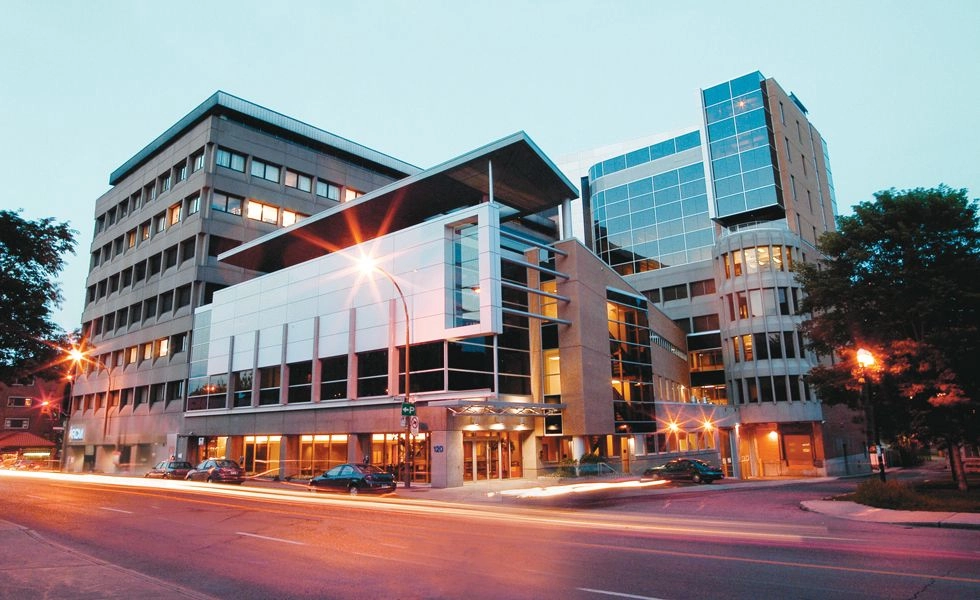

Embedded within the prestigious IRCM, our physical laboratory bridges the critical gap between in silico generation and in vitro reality.
Rapid, large-scale screening of computationally engineered binders. Executing proprietary validation workflows within native cellular contexts.
Direct integration with top-tier microscopy, genomics, proteomics, immunology, and oncology resources, enabling accelerated development pipelines.