
ProxAI combines machine learning, structural biology, protein engineering and validation assays to accelerate therapeutic discovery for advance biological targets beyond traditional methods.
Submit your target and receive an engineered construct supported by structural models and cellular validation against intra- or extracellular targets.



De novo binders and custom antibody formats designed against complex or undruggable epitopes.
Direct functional proof-of-concept and cellular degradation verification in native disease models.
Computational stability, solubility optimization, and tailored ternary-complex geometry engineering.
Sequence-validated lead candidates ready for pipeline progression and preclinical asset expansion.
A highly reproducible milestone framework tailored to your program's specific target.
Securely upload your structural files via our air-gapped intake portal or identify your therapeutic target. Choose your E3 ligase and the ProxAI engine maps the exact geometric coordinates and uncovers interaction hotspots.
Our polyvalent deep learning models generate over 100,000 bioPROTAC candidate sequences tailored to bind exclusively your target. Candidates are ranked and computationally prioritized.
The library shifts to physical cell systems. Using automated multi-parameter FACS tracking, we screen millions of cellular variants in real-time, pulling out elite bioPROTACs, inducing the best target degradation.
Top bioPROTAC assets undergo meticulous characterization, and cross-reactive safety assays to ensure absolute specificity. Access data through our secured portal.
Addressing the structural and functional bottlenecks holding back targeted protein degradation pipelines.
The problem: CRBN and VHL dominate the field's E3 ligase-related module choices, driving acquired resistance and limited tissue specificity.
Expanding past CRBN and VHL usually means panning a physical library against a new ligase from the ground up. You get a target-binding module built directly from your target's structure instead — compatible with MDM2, IAP, or your proprietary E3 system — with binding activity already confirmed in cells before it reaches your bench.
The problem: Small-molecule ligand discovery for novel E3 ligases runs into family-wide promiscuity — candidate ligands often bind several ligases within the same family, and where they do land on the right one, binding competition inside a conserved pocket keeps affinity low.
A protein binder built directly against your chosen E3 ligase's structure — engineered for the selectivity and affinity a small-molecule screen can't reliably deliver against a new ligase family member.
The problem: A degrader still needs a target-binding module. Flat surfaces, disordered regions, and complex PPI topologies defeat small-molecule warhead discovery the same way they defeat any small-molecule campaign.
A miniprotein or nanobody as the target-recognition module of your degrader — built directly from your target's structure, for interfaces with no pocket to speak of.
The problem: A binder that hits the target isn't automatically a working degrader. If the epitope positions the target's accessible ubiquitination sites away from the E3 module, transfer never happens — a perfectly good binder can still produce zero degradation.
Not just affinity. An epitope chosen with the ternary complex geometry in mind — because a binder that can't support productive ubiquitination isn't a target-binding module, it's just a binder that doesn't do anything for your program.
Modules and constructs designed from structure and delivered with cellular validation.
The Target-Recognition Half
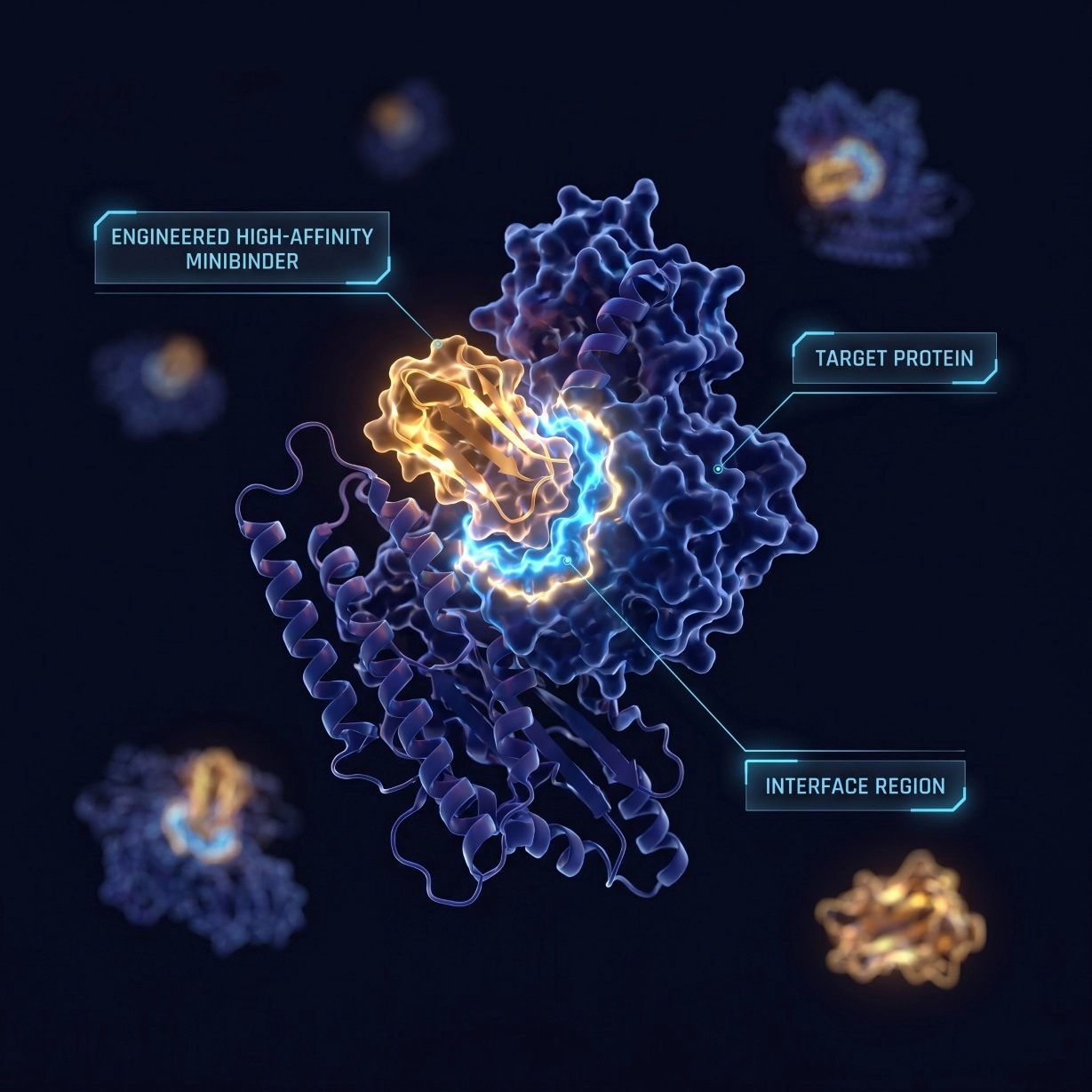
The target-recognition module of your bioPROTAC or molecular glue: a binder built for a chosen epitope and positioned for productive ternary-complex geometry, not just affinity. Compatible with VHL, CRBN, MDM2, IAP, or your proprietary E3 system.
The E3-Recognition Half
The E3-recognition module of your bioPROTAC or molecular glue: a binder built for your chosen E3 ligase — including any of the 40 novel, tissue-mapped candidates in our library, or an understudied ligase you bring us — positioned for productive ternary-complex geometry, not just affinity.

Both Halves, One Construct
Bring your own target binder, your own E3 binder, both, or neither — we match the two with an optimized linker and deliver one assembled bioPROTAC construct, validated as a complete molecule rather than as separate parts.
The Underlying Capability
The same underlying capability, standalone — a binder for direct PPI disruption, intracellular targets, or any interface a small molecule has already failed against.
Deliverable:Binder sequences, structural model of the binder-target complex, and confirmed cellular target-binding activity.
Deployment
Delivery-ready binder payloads in LNP-formulated mRNA or plasmid format — pick the expression strategy that fits your program's onset speed and durability needs.
On our roadmap:Cell-specific delivery via engineering the nanoparticle surface with protein binders that engage cell-type-specific receptors.
Connect with our business development and scientific advisory teams.
Submit your details below to
schedule an exploratory briefing and initiate mutual NDAs.
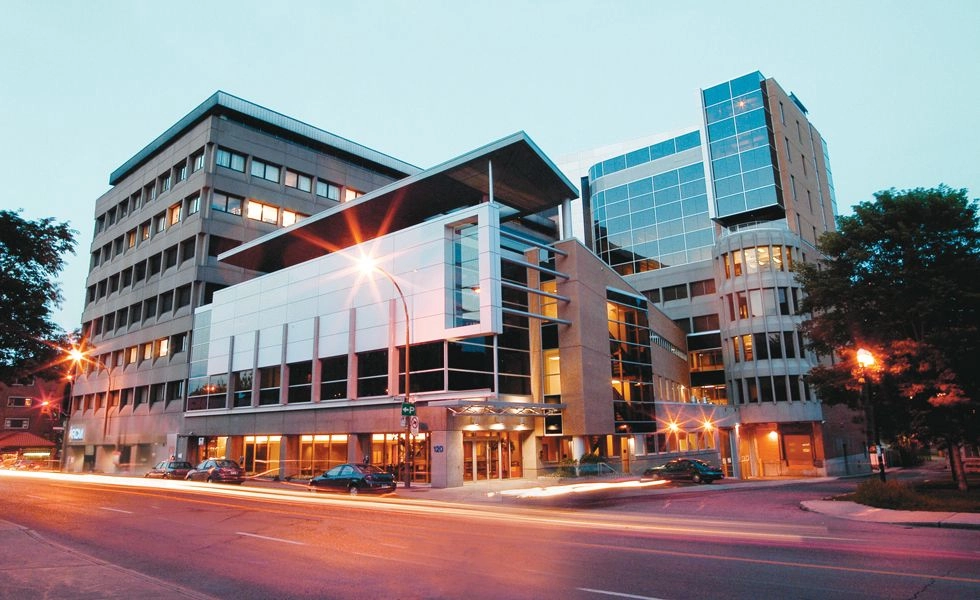

Embedded within the prestigious IRCM, our physical laboratory bridges the critical gap between in silico generation and in vitro reality.
Rapid, large-scale screening of computationally engineered binders. Executing proprietary validation workflows within native cellular contexts.
Direct integration with top-tier microscopy, genomics, proteomics, immunology, and oncology resources, enabling accelerated development pipelines.